ASVAB Assembling Objects Study Guide
Assembling Objects is the oddball of the ASVAB. There is nothing to memorize, no formulas, no vocabulary. Every question is a picture puzzle that asks whether you can rotate shapes in your head and predict how parts fit together. Because it is a pure skill test, most people ignore it, which is exactly why a little deliberate practice moves the score so much. This guide explains what the subtest measures, who actually uses it, the two puzzle types you will face, and how to train for them.
What Assembling Objects Measures
Assembling Objects (AO) measures spatial ability: the capacity to look at two dimensional shapes, mentally rotate them, and visualize how they connect or combine. Each question shows a starting picture, followed by four answer choices, and asks which choice shows the correct result. This is the same mental skill you use reading a map, packing a trunk, or following furniture assembly diagrams, and it correlates with success in jobs that involve blueprints, mechanical layouts, and equipment assembly.
As with every ASVAB section, there is no passing or failing AO. Your goal is simply to add points, because points become qualifications. A strong AO score costs little study time and can tip a composite over a job’s cutoff.
Where Assembling Objects Counts
AO does not feed the AFQT, which comes only from the verbal and math subtests. It also has the narrowest job impact of any section. AO appears on the CAT-ASVAB, the computerized version given at MEPS, and its score is used mainly by the Navy, which includes it in composites for certain ratings, historically including some mechanical and construction fields. The exact composites and cutoffs vary by branch and change over time, and most Army, Air Force, and Marine Corps composites do not use AO at all.
So should you bother? If the Navy is on your list, yes, without question. If you are undecided, AO is cheap insurance: a few hours of practice protects options you may not know you want yet. Since where you enlist shapes which composites matter, it helps to read our guide on how to choose a military branch before deciding how much time to give this section.
Question Count and Time Limit
On the CAT-ASVAB, Assembling Objects has about 15 questions with a time limit of about 18 minutes, a little over a minute per puzzle. Sessions with unscored tryout questions can run slightly longer, so treat these numbers as close estimates.
| Format | Questions | Time Limit |
|---|---|---|
| CAT-ASVAB (computer) | About 15 | About 18 minutes |
The Two Puzzle Types You Will See
AO is figure based, so instead of a topic list, you prepare for two puzzle formats:
- Connection puzzles. The first frame shows two or more shapes, each marked with a labeled point and a line indicating where a connecting line or dowel attaches. The correct answer shows the same shapes joined at exactly those marked points, even though the shapes may be rotated. Wrong answers attach the line to the wrong spot on a shape, use a mirror image of a shape, or swap which shape gets which attachment point.
- Assembly puzzles. The first frame shows a scattered set of flat pieces, like fragments of a jigsaw puzzle. The correct answer shows the one figure those exact pieces form when fitted together. Wrong answers use a piece that was never in the set, drop a piece, resize a piece, or flip one over.
In both formats, rotation is always allowed and mirroring never is. A shape may be turned to any angle in the answer, but it may not be flipped into its reflection. That single rule eliminates more wrong answers than any other insight on this subtest.
How to Study for Assembling Objects
Spatial skill improves with repetitions, and the improvement comes fast at first. Work timed sets of AO style puzzles several times a week for two or three weeks. As you practice, force yourself to articulate why each wrong answer is wrong: flipped piece, wrong attachment point, missing piece, wrong size. Naming the flaw builds the checking habit you will rely on under time pressure.
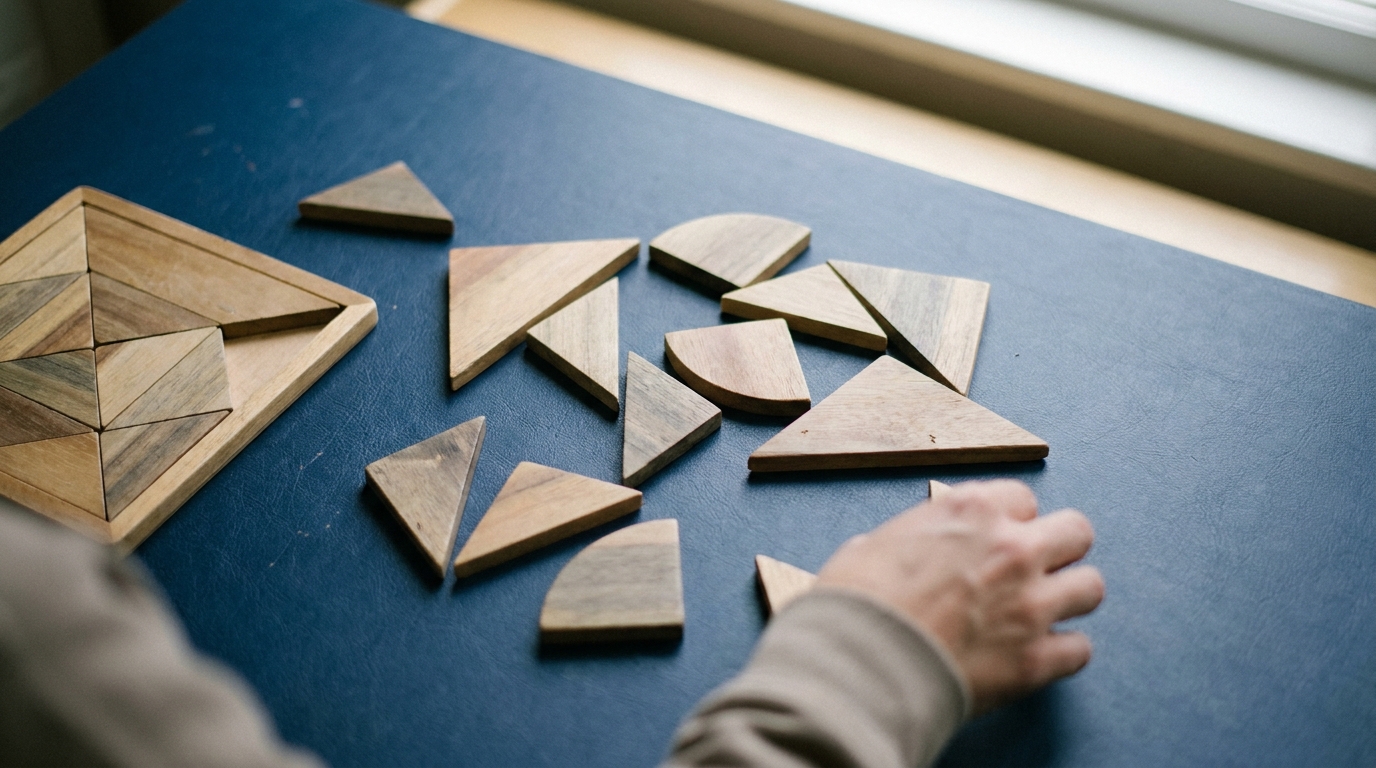
Supplement with anything that exercises mental rotation. Jigsaw puzzles, tangrams, and block building games all train the same circuitry. Even sketching helps: draw an irregular shape, then try to draw it rotated a quarter turn without turning the paper, and check yourself by rotating the page. The goal is comfort holding a shape in your mind while it moves.
Finally, practice pacing. A bit over a minute per question is enough time to check every option once, but not enough to agonize. Train yourself to eliminate, choose, and move.
Common Mistakes to Avoid
Strategy Walkthrough: The Anchor Piece Method
Since AO is visual, here is the reasoning process in words, using an invented assembly puzzle. Imagine the first frame shows four flat pieces: a large quarter circle, a narrow triangle, a small square, and an L shaped piece. The four answer choices each show an assembled figure.
Do not try to solve the jigsaw. Instead, pick an anchor: the most distinctive piece, here the L shape, because its bend makes flips easy to spot. Scan the four options only for the L. Suppose option A shows the L bending the wrong way; that is a mirror image, so A is gone. Option B shows a figure with no L shaped region at all, so B is gone. Two options remain, and you have spent maybe twenty seconds. Now switch anchors to the quarter circle. Suppose option C shows a curved edge that spans a half circle rather than a quarter; the piece was resized, so C is gone. Option D remains: confirm it quickly by counting four piece regions and checking that the triangle and square appear at plausible sizes. Choose D and move on. You never assembled anything; you eliminated three flawed pictures by tracking one piece at a time. That is the entire skill, repeated fifteen times.
Put It Into Practice
Assembling Objects rewards a small toolkit: know the two puzzle types, hunt for mirror flips, verify marked points, count pieces, and eliminate with an anchor piece. A modest investment here protects Navy options and rounds out your score profile.
Get a feel for the whole exam with a free ASVAB practice test, then keep building with our bank of 1,600+ practice questions covering every ASVAB section with clear explanations.
There is no failing score waiting for you on test day. There is only the list of jobs your scores unlock, and AO is one more place to make that list longer.